PJM 5CP and NSPL peak forecasting
Know which hours will set next year's energy bill, before they happen.
A handful of peak hours decide a full year of PJM capacity and transmission charges. PJM Peak Tracker forecasts those hours for the RTO and your utility zone, then alerts you in time to cut load when it counts.
Already have an account? Log in
Why a few hours matter so much
PJM doesn't bill capacity and transmission based on how much electricity you use all year. It bills based on your demand during a small number of critical peak hours, and that number is locked in for the next 12 months.
Capacity charges (5CP)
Your share of load during summer's five highest RTO-wide hours, no two on the same day, sets your Peak Load Contribution for the following planning year.
Transmission charges (NSPL)
Each utility sets zonal transmission costs from its own peak hours, using the methodology in its tariff. Those aren't always the same hours as the RTO peak.
Peak shaving pays off
Reducing demand during the right few hours, not all year, can meaningfully lower next year's bill. Pre-cool, shift production, or run backup generation only when it counts.
How it works
Pick your zone
Choose the utility zone your facility is in. Capacity (RTO 5CP) is tracked for everyone automatically.
Watch the week ahead
PJM's 7-day load forecast is compared against this season's top hours, so you see which days are actually at risk.
Get alerted, then curtail
When tomorrow looks like a peak, you get a watch email that afternoon and a confirmation about 3 hours before the peak hour. Reduce load for those hours and your charges for next year come down.
What you get
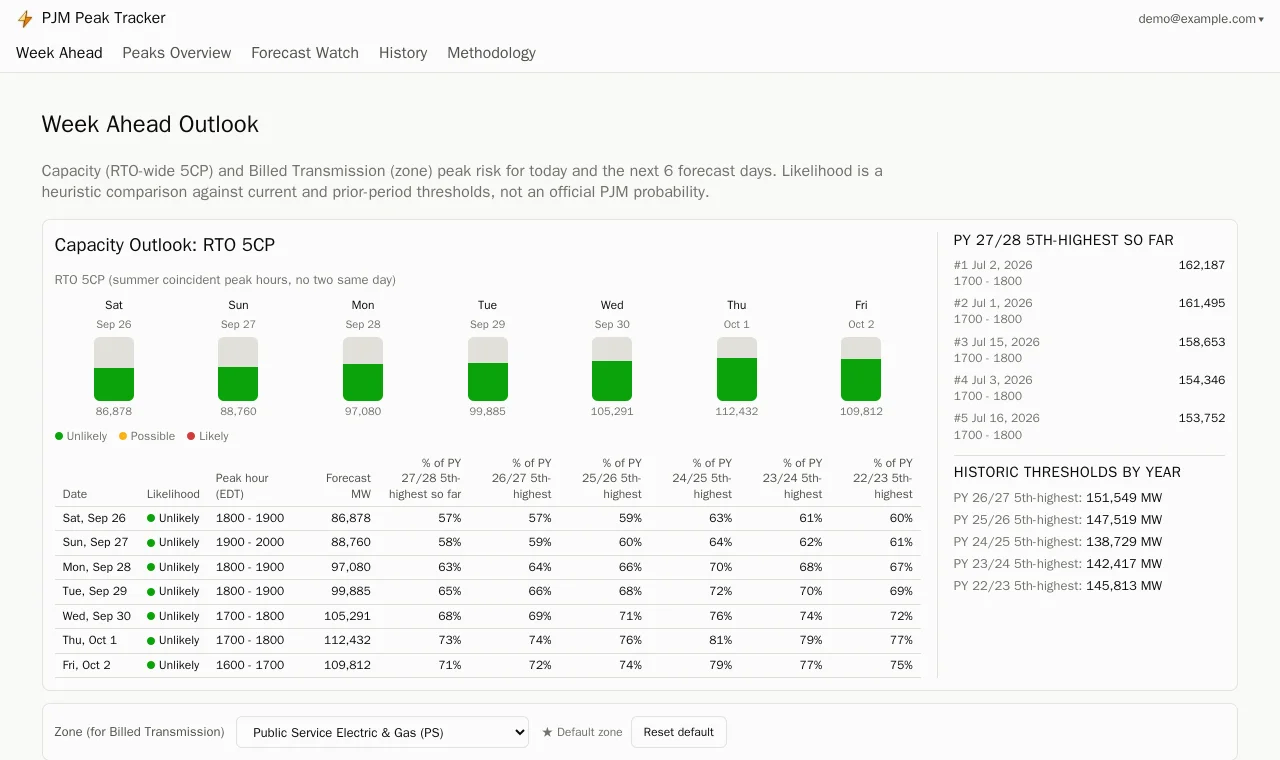
Week Ahead Outlook
Every day for the next week, rated Unlikely, Possible or Likely to land in this year's peak set, for both the RTO-wide 5CP and your own utility zone.
Real-time peak alerts
A watch email the afternoon before a likely peak, then a second email about 3 hours before the peak hour that confirms it or tells you to stand down.
Week Ahead email
A Monday-morning summary of capacity and transmission risk for the zones you pick, so you can line up crews and production schedules in advance.
Live season scoreboard
The current top-5 peak hours and how close each forecasted hour is to knocking one of them out, updated as PJM publishes new load data.
Your utility's rules, not a guess
Transmission peaks use each zone's own tariff methodology: how many hours count, which months, and whether they must match the zone's own peaks.
Checked against PJM
Past seasons are recomputed from raw load data and compared with PJM's published NSPL values, so you can see how closely the numbers match.
Frequently asked questions
What is PJM 5CP?
5CP stands for five coincident peaks. PJM takes the five highest hourly loads across its whole footprint (the RTO) between June 1 and September 30, no two on the same day. Your demand during those five hours sets your Peak Load Contribution (PLC), which drives your capacity charges for the planning year that starts the following June.
What is NSPL and how is it different?
Network Service Peak Load (NSPL) sets transmission charges. Instead of the RTO-wide peak, it's based on your transmission zone's own peak hours, and each utility divides that total among its customers using a methodology written into its tariff. Some use a single peak hour, others average several. PJM Peak Tracker models each zone's rules separately.
How much can peak shaving save?
It depends on your load profile and your supply contract, but because capacity and transmission charges are fixed for a full year from a handful of hours, cutting load during those specific hours can reduce a meaningful part of the next year's bill. The hard part is predicting the hours. That's what this tool is for.
When do PJM peaks usually happen?
Summer capacity peaks almost always fall on hot, humid weekday afternoons, typically between 1500 and 1900 ET. They cluster in heat waves, so one hot week can set several of the five. Transmission peaks follow each zone's own pattern, and some zones count winter months too.
Is this affiliated with PJM?
No. PJM Peak Tracker is an independent informational tool built on PJM's publicly published load and forecast data. It isn't endorsed by PJM Interconnection, L.L.C. Always confirm against PJM's own published sources before relying on it for a decision.
Stop guessing when the peak is.
Set up your zone and alerts in a couple of minutes.